
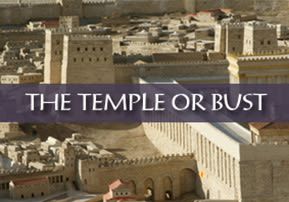
The Temple or Bust
Imagine standing at history’s happy conclusion when the entire Jewish people will unite in peace and become a real light unto the nations...

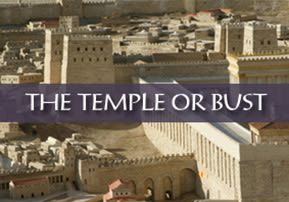
One evening about ten years ago, I visited the Beit HaMikdash, the Holy Temple in Jerusalem. I’m not talking about the Temple Mount with the Dome of the Rock sitting on ancient Jewish ruins, but the actual living Temple with its golden menorah and the Levites singing King David’s original melodies in multi-leveled harmony.
I was there. I touched its stones. I saw unblemished sheep and goats designated for offerings on the altar with its perfect column of smoke reaching the heavens. And I felt an overwhelming sense of connection to the 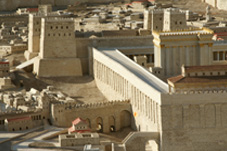 Divine, an awareness that I was standing at the center of existence.
You may think I’m either lying, insane, or drunk because the Second Temple was destroyed 1,942 years ago and the Third Temple hasn’t been built yet.
So how could I have possibly visited the Holy Temple a decade ago?
Because I was under hypnosis. I allowed a hypnotist to bring me to the Beit Hamikdash when I was in a hypnotic state, and it felt both real and amazing.
Just imagine what it will really feel like to be there.
Just imagine seeing with your own eyes the miracles of the King’s palace, the holiest place on earth in its idealized state. Imagine experiencing an unfathomably intense connection with the Creator on the exact spot where Noach offered his sacrifice after the flood, where Avraham nearly sacrificed Yitzchak and where Yaakov dreamed his prophetic dream of angels ascending and descending a ladder to the heavens.
Imagine making the same awe-inspiring pilgrimage to the Temple our ancestors made during the 410 years the First Temple stood and the 420 years the Second Temple stood. Imagine reaching the highest state of holiness as the Kohanim perform their service in their priestly garments and the Levites sing and play their instruments on indescribable melodies.
And imagine standing at history’s happy conclusion when the entire Jewish people will unite in peace and fulfill our potential in our service to Hashem. We’ll learn Torah properly and completely, and we’ll be a real light to the nations as the entire world recognizes the kingship of Hashem.
For nearly 2,000 years, Jews have yearned for all this. Jews have yearned for the Temple to be rebuilt.
So it’s no wonder why some people throughout history tried to build the Third Temple themselves.
According to a cultural anthropologist at Stanford University, Christopher Columbus (who may really have been Jewish) set out to sail to Asia only to acquire the gold he would need to buy Jerusalem from the Muslims and rebuild the Holy Temple.
Another story relates that the Jews of Spain held a convention to begin building the Third Temple. They had already raised the money to buy the Land of Israel from the sultan (who was willing to sell it), and the Spanish Kohanim had already started learning the laws of the Temple service.
At that convention, one of the community elders stood up and said, “We need a sign from Heaven to build the Temple. Who says we have the right to do this?” This began a heated debate, and they decided to wait and meet again the following year.
The year of that convention was 1491. The following year, the Spanish Inquisition came to a head with the expulsion of the Jews from Spain. And that golden moment of rebuilding the Temple seemed forever beyond our grasp.
Today, we have the Land of Israel. And the in-gathering of the exiles the prophets foresaw is happening before our eyes. So even though a mosque sits on top of where the Beit Hamikdash should be—and Jews currently aren’t even allowed to pray on the Temple Mount—shouldn’t we start preparing for Temple’s rebuilding?
But as that Jewish elder asked in Spain more than 520 years ago: Do we really have a right to do this?
There are those who throughout history say an emphatic yes.
Rabbi Yisachar Shlomo Teichtal, who was martyred in Auschwitz, wrote that we do indeed have a right to start building the Temple. He quoted the the Tosfos Yom Tov which says we’re going to build the Beit HaMikdash ourselves — and 40 years after that Mashiach will come.
This is a bit controversial; many believe the Beit HaMikdash won’t be man-made at all but instead will descend from Heaven.
Rabbi Teichtal’s position is really a compromise. He argued that first we’ll build the earthly Beit HaMikdash, and afterwards the supernal one will descend upon it. And the Malbim and the Tikkunei Zohar agree.
So it seems those who want to build the Beit HaMikdash today are in good company.
Of course, it’s not realistic to march up to the Temple Mount (which has been under Muslim occupation for centuries) with pick axes and shovels and start building the Third Temple right now. But with our Gedolim telling us that ours is the generation before Mashiach, it looks like the right time to build the Temple could be very soon, G-d willing.
What’s more, it’s no secret that some construction towards the reality of the Third Temple has already begun.
Thanks to the Temple Institute, many of the sacred vessels for the service of the Holy Temple have been reconstructed and are waiting for the Third Temple to be used. These include the menorah, the table of show-bread, the golden incense altar, the garments of both the Kohanim and the High Priest, musical instruments and dozens of other vessels.
But what about the rest of us who want to do something to build the Third Temple?
What can we do to prepare for its construction (not to mention to really feel its absence in our daily lives)?
Here are two suggestions.
The first is to study Kodshim, the sections of Torah that deal with the Temple Service.
The Chofetz Chaim says that learning Kodshim helps bring the geulah (the complete redemption of the Jew people) closer. He also quotes the Talmud that says when we learn Kodshim, it’s considered as if we actually built the Temple in our days, and when we learn about karbanot (the sacrifices) it’s as if we actually brought them (Menachos 110a).
There are many books and resources in English—including The Holy Temple of Jerusalem by Rabbi Chaim Richman, The Holy Temple Revisited by Rabbi Leibel Reznick, Kitzur Seder Haavodah: A Step-by-Step Guide to the Avodah of the Beis Hamikdash by Rabbi Aaron Kaplan and the Temple Institute website (www.templeinstitute.org).
The second suggestion to prepare for the Third Temple is to say Tikkun Chatzot.
Tikkun Chatzot is the midnight service when we get up at (or stay up until) halachic midnight (which according to Rebbe Nachman of Breslev is six hours after nightfall) to lament the destruction of the Second Temple and yearn for the building of the Third Temple.
Rebbe Nachman himself declared that Tikkun Chatzot is crucial for rebuilding the Temple. He said, “G-d is now ready and waiting to rebuild our Holy Temple. For our part, we should be very careful to do nothing that might delay the rebuilding. Indeed, we ourselves should make an effort to rebuild it—by getting up at Chatzot each night to mourn over the destruction” (Likutei Moharan II, 67).
For an excellent guide to Tikkun Chatzot with an English commentary and translation, I strongly recommend The Breslov Research Institute’s The Sweetest Hour by Rabbi Avraham Greenbaum [Editor’s Note: A revised edition is available at BRI.]
Saying Tikkun Chatzot and studying Kodshim, however, are just two suggestions. But whatever we do, let’s anticipate the return of the service of the Beit Hamikdash when the kingship of G-d will be universally recognized and the world will be a far better place (may it be speedily in our days).





7/10/2012
hypnosis? kosher? i don't think the author is trying to tell people that hypnosis is kosher
7/10/2012
i don't think the author is trying to tell people that hypnosis is kosher