
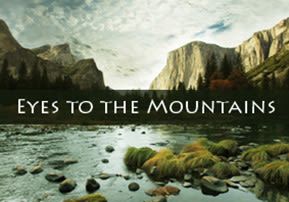
Eyes to the Mountains
Kabbalah teaches that knowledge is the point between the shoulders. The Holy Temple in Jerusalem was situated in the basin between the shoulders of the mountains surrounding it...


In Psalms ( 121:1) it is written: “I lift my eyes to the mountains, from where shall my aid come?”
This verse alludes to the two mountains Grizim and Eival. The Priests and Levites stood in the valley between Mount Gerizim and Mount Eval, lifting their eyes first to the right and then to the left to express blessing and curse.
In Hebrew, the word for “from where” in the above verse is mayayin. This word can also be understood to mean “from ayin,” from the Divine Nothingness, the inner essence of the eye (also pronounced ayin). W hen we lift our physical eyes to Heaven, we reach the vision of Divine nothingness, which is the source of all aid and salvation.
In Job ( 28:12) it is written: “From where will wisdom be found?” Chassidut illuminates this verse in a deeper light: Wisdom comes from ayin, from Divine nothingness. Kabbalah and Chassidut explain that wisdom, represented here by Mount Grizim, comes into existence only when it unites with understanding, represented here by Mount Eival. Even though Mount Grizim represents apparent blessing, it has a hidden unity with the curse of Mount Eival, which balances the secret of the blessing.
Mount Moriah
In the above verse in Psalms 121, the word for “the mountains” is heharim. When the letters of heharim are rearranged, they spell  hamoriah, the Temple Mount in Jerusalem. The word moriah means “insence” or “teaching,” alluding to God’s word to the Jewish People and all humanity that emanates from the holy temple on Mount Moriah (“teaching”), and to the ultimate service and union with God in the Holy Temple (“incense”).
Hamoriahequals 260, the same numerical value as Gerizim. According to the principle that the left is included within the right, Mount Eval is included within Mount Gerizim. These two mountains unite at Mount Moriah.
In Kabbalah, Mount Moriah corresponds to yet another point in the geometrical configuration of the mountains. The Hermon is the crown at the top, Mount Gerizim and Mount Eval are the two eyes of wisdom and understanding to the right and left, and Mount Moriah corresponds to knowledge. Kabbalah teaches that knowledge is the point between the shoulders. The Holy Temple in Jerusalem was situated in the basin between the shoulders of the mountains surrounding it. This image is called knowledge, the power that connects the mind (wisdom) to the emotions of the heart (understanding). When something connects two seemingly opposite faculties, its source is higher than the faculties that it connects. Thus, the source of knowledge is higher than both wisdom and understanding. It derives from the crown of Mount Hermon. The point of Mount Moriah reflects the crown, and is situated between and below Mount Gerizim and Mount Eval, directly opposite Mount Hermon. Mount Moriah is the culmination of the three preceding mountains.
Mount Sinai
The four mountains mentioned above correspond to the sefirot of crown, wisdom, understanding, and knowledge. These mountains are all in the Land of Israel. Yet another mountain with deep significance for the Jewish People is Mount Sinai, where God gave us the Torah. Mount Moriah, which represents the Torah manifesting in the world, must relate to Mount Sinai, where the Torah was given. The numerical value of Sinai is 130. This is the same value as ayin, and is half of 260, Moriah. The relation of Sinai and Moriah is the deep Kabbalistic secret of half to whole.
We have meditated on five mountains, whose progression is from the Torah, to the Temple, the Mashiach and the mission of the Jewish People to spread the knowledge of the Divine Nothingness throughout the world.
***
Reprinted with courtesy of www.inner.org



2/02/2015
cabala
si me gusta aprender de la cabala ,muchos la desprecian yo no si acepto la descubri pero no se meditar,deseo cambiar eventos en mi vida este correo que escribo es de mi esposa ella teme no sabe le han dado malas ensenanzas ,no estamos en la era del melec hamashiaj ,debo yo de apresurar su venida con mi vida .
2/02/2015
si me gusta aprender de la cabala ,muchos la desprecian yo no si acepto la descubri pero no se meditar,deseo cambiar eventos en mi vida este correo que escribo es de mi esposa ella teme no sabe le han dado malas ensenanzas ,no estamos en la era del melec hamashiaj ,debo yo de apresurar su venida con mi vida .